It’s really too bad that there is no way to know how a camera or other electronic device will work out until you’ve long since bought it. But now and then one gets lucky. The subject of this post, the Panasonic Lumix DMC-FX01, is a case in point. The FX01 was given to me by my wife Lisa, as I was preparing to ride my motorcycle across the continent and back in August 2006. |
 |
In the photo above is the Kodak DC 3400 on the right, and the camera that replaced it, the FX01. Note the size difference between the two cameras. The Kodak was a 2MP digital camera, and built like a brick to take abuse. It also handled like a brick. And there was no way to consider it a “pocket” camera. But it fit in the glove compartment of the truck and in the saddlebag. The FX01 was truly a pocket camera. It easily fit into a jacket pocket, and weighed nearly nothing, so it was rarely out of my reach. I have captured over 26,000 frames with it without major problems of any kind. I recently found “ghosts” on the photos and thought the sensor might be going south. It turned out to be a dirty lens – the first time I’ve had to clean it in four years. |
 |
The Menu system (shown above) is simple. My two grandchildren mastered the menus (and all other controls) on this camera between the ages of 2 and 4 years. The secret to that was simple. I let them take photos with it, and only showed them features when asked. This is not a testament to the beating it took at the hands of toddlers, since both children were oddly careful with the camera. But it did take a beating in my pockets, in my backback, and in the motorcycle's saddlebags. |
 |
There was little control with this 6MP consumer point-and-shoot camera, but a tripod helped. Also helpful was the exposure compensation control shown in the photo above. |
 |
In all, the FX01 I have is still running strong (and with a cleaner lens) after several succeeding generations of digital pocket cameras have passed it by technologically. And it can still capture a good image. Now that’s something. My experience with the longevity of digital cameras has been good, so far. It is quite unlike my experience with CD/DVD players, which seem to need to be replaced as often as boxes of Kleenex... |
Saturday, June 26, 2010
FX01, A Retrospective Look


Out West
Recently, Steve Vaughn commented about living "out west". I know what he meant (it doesn't hurt that I met Steve when I was 4 years old and entering the public school system). He and his wife Darryl moved to Richland, WA from the East Coast last year. He is an avid fly fisherman, and in a good location to explore the many rivers in Washington and Oregon. While he is here, working in Richland, and living out west there is so much to see.
I like to keep track of the Vaughn's near-epic move to Washington and how they are settling in, etc., on Steve's blog, Nomads at http://nomadslvaughn.blogspot.com/.
"Out West" is the way I thought of it when I was young, since I lived in the northeast. It was towns like Durango, Cortez, Cheyenne, Sundance, Tucson, and Santa Fe. It was Conestoga wagons and Apaches, Winchester rifles and Lakotas, cattle drives and Dodge City, gold rushes and railroad booms.
My vision of the world is centered in the West, now. "Back East" is where I grew up. I first realized that when I rode my Road Star to Long Island and back in 2006. On the ride home when I crossed over the border between Kansas and Colorado, I suddenly thought, "I'm home, I'm back in the West".
But though I've been here since 1971, I have an idea similar to Steve's about being here in the West: There simply isn't enough time to see everything...
The photo below was captured on a Panasonic Lumix DMC-FX01 in August 2006. The view is east from Ghost Rocks in Utah, just off Interstate 70. There is no mistaking this for anything other than a view of the West.

I like to keep track of the Vaughn's near-epic move to Washington and how they are settling in, etc., on Steve's blog, Nomads at http://nomadslvaughn.blogspot.com/.
"Out West" is the way I thought of it when I was young, since I lived in the northeast. It was towns like Durango, Cortez, Cheyenne, Sundance, Tucson, and Santa Fe. It was Conestoga wagons and Apaches, Winchester rifles and Lakotas, cattle drives and Dodge City, gold rushes and railroad booms.
My vision of the world is centered in the West, now. "Back East" is where I grew up. I first realized that when I rode my Road Star to Long Island and back in 2006. On the ride home when I crossed over the border between Kansas and Colorado, I suddenly thought, "I'm home, I'm back in the West".
But though I've been here since 1971, I have an idea similar to Steve's about being here in the West: There simply isn't enough time to see everything...
The photo below was captured on a Panasonic Lumix DMC-FX01 in August 2006. The view is east from Ghost Rocks in Utah, just off Interstate 70. There is no mistaking this for anything other than a view of the West.

Constant Gardener
 |
California Poppies I'm not sure what happened. I bought several varieties of flower seeds last fall; California Poppies, Vinca, Phlox, and Cosmos. Thought I'd get a jump on the spring and planted a large seed bed. The poppies did well, though they've now generally died back. But they grew nearly twice their average height. The Cosmos are now over four feet tall. |
 |
Cosmo Lisa brought home 3 miniature Mums last fall. I planted them in the front flowerbed, along with the Vinca, Phlox, and Geraniums, figuring they wouldn't grow much taller than their neighbors. But they are quite large plants now, each with at least 50 blooms. There must be something in the soil. Something that doubles plant size. Even the Phlox and Vinca are twice their usual size. The mutations have ruined my landscaping plan, though - I had everything laid out according to relative maximum heights... |
 |
Zinnia The Constant Gardener part: Everything is way too overgrown now. I spent six hours today thinning out, weeding, potting the mutant "miniature" Mums, and replacing thinned plants with new Vinca and Zinnias. The Vinca does well in this climate. Maybe this planting will last through to Fall... About The Photographs The digital photos in this post were made with a Nikon D200. Photos were resized for Web display. The other particulars are listed below. California Poppies - Nikon manual Series E 28mm 1:2.8, 1/200, f/8, ISO 200. Cosmo - Nikon AF VR 18-105mm f/3.5-5.6 G, 1/640, f/5.6, ISO 400. Zinnia - Nikon AF VR 18-105mm f/3.5-5.6 G, 1/100, f/14, ISO 400. |
Thursday, June 17, 2010
Mill Creek Canyon
The photos in this post were made in Mill Creek Canyon at the edge of the San Bernardino Mountains near Mountain Home Village in Southern California.

Mill Creek is fed by numerous creeks flowing from the mountains through the village of Forest Falls. The water rolls through Mill Creek Canyon and onto the floodplain north of Mentone, where it joins the Santa Ana River.


Mill Creek is fed by numerous creeks flowing from the mountains through the village of Forest Falls. The water rolls through Mill Creek Canyon and onto the floodplain north of Mentone, where it joins the Santa Ana River.

Aero

Photos from a classic automobile show in Riverside, CA. Nikon D200, Nikon AF VR 18-105mm f3.5-5.6.
Sunday, June 13, 2010
Olympus Trip
I don’t recall when this camera showed up. Really. One day many vaguely recalled years ago, it suddenly appeared in my office. I thought it was something Lisa had brought home (she didn't), so I let it rest on my desk for a short time, moved it to a drawer, then transferred it to yet another drawer years later. A couple weeks ago I pulled it out of the drawer and set it on the corner of the desk. I looked at it occasionally every day. Though it obviously wouldn’t replace the Nikon N90s, it had to have some function, I thought. Otherwise, why did I have it? The Olympus Trip XB40 AF is a decade-old point-and-shoot camera. It has a 27mm lens and an Autofocus capability of sorts. To engage the autofocus, press the shutter button down halfway. Press the shutter button all the way down to take the photo. |
 |
It was a somewhat interesting design. For a brick. Well, a plastic brick with a sliding lens cover. But in operation it is quite like so many millions of other point-and-shoot cameras. I finally loaded the camera with two AA batteries and a roll of Kodak Gold 200. The film loaded easily. After pulling the leader out to the take-up spool, shut the rear camera door, turn on the camera, press the shutter button once, then the camera loads the film. The camera back is equipped with a programmable date/time stamp function. These artifacts must be everywhere… And I’ll bet that this particular camera has a real value of about $3.00, just a bit less than the film I loaded in it. |
 |
The camera is about as simple as these types of cameras got – until the disposable cameras came along. I put the camera in Lisa’s car – in the same place where she keeps a disposable camera. I’m wondering how the camera works in its intended role of cheap snapshot camera. After all, that’s what it was designed for. I’ll update this story when I know if the camera worked and how the film looks in general. This could be the jump-off point to write in favor of not using the disposable cameras. Put less plastic in waste bins and trash cans by using old point-and-shoot cameras like the Olympus Trip. You know the dance. Fortunately, this post is not about that. I'm just interested to see if the camera has a function, and if it performs it adequately...Stay tuned. For a different viewpoint (and better photo) of this camera, see http://www.flickr.com/photos/artysmokes/4326527484/ |
Saturday, June 12, 2010
The Green Desert
Making use of our yearlong National Parks Pass, I was through the southern gate at Joshua Tree around 6:40 this morning. I haven't been to Joshua Tree since winter, and though there was plenty of rainfall in the past few months, I didn't expect as much green in the arid landscape this late in the year. Usually by mid-June the shrubbery is dry and brown.
 |
The shrubbery was so green that it looked much like farmland in the distance. |
 |
Smoke Tree Wash. Smoke trees are found in desert washes. The washes have deep moisture reserves, but more importantly, flash floods spread the tree's seeds. |
 |
Some plants are still blooming. |
 |
The ocotillo in bloom above, adds a peppering of red blooms against the blue sky. |
 |
Closer view of an ocotillo. The leaves sprout on the trunk and the plant blooms only after adequate rainfall. Blooming is not seasonal. |
 |
Honeybees were noisily engaged with these flowers. |
 |
More color. |
Grand Teton - Yellowstone Trip
It was a very loose plan.
We’d pack up the Subaru Forester at the end of May and head toward the Grand Teton and Yellowstone National Parks in northwestern Wyoming. There were a number of parks, monuments, preserves and wilderness areas that we could pass through, particularly in Utah. I’d do the majority of the driving while Lisa handled the maps and we’d stop for the night when we wanted. Loose plans are the best plans on a road trip.
Digital photos of the trip are shown below.
 |
Zion National Park, Utah |
 |
Zion National Park, Utah |
 |
Hoodoos in |
 |
Bryce Canyon National Park, Utah |
 |
Capitol Reef National Park |
 |
Irrigation equipment near Torrey, Utah  |
Grand Teton National Park, Wyoming |
 |
Grand Teton National Park, Wyoming |
 |
Old Faithful, Yellowstone National Park, Wyoming |
Thursday, June 10, 2010
California Poppies
The photograph below is really of orange shapes with a semi-blurred background. The orange shapes are California Poppies, which grow wild across the state. On a whim, I planted the wildflower from Burpee seeds in January. The poppies have done well so far in our flowerbeds, though the coming summer heat may change that.
The semi-blurred background was intentional. I wanted focus on all five blossoms, so I stopped down to f/8 and focused where I judged the near 1/3rd point of the grouping to be. This smaller aperture doesn't produce the bokeh of f/2.8, but there is a mild blur that draws the eye back to the blossoms. Shutter speed was 1/250. 28mm Nikon manual focus lens.

The semi-blurred background was intentional. I wanted focus on all five blossoms, so I stopped down to f/8 and focused where I judged the near 1/3rd point of the grouping to be. This smaller aperture doesn't produce the bokeh of f/2.8, but there is a mild blur that draws the eye back to the blossoms. Shutter speed was 1/250. 28mm Nikon manual focus lens.

Tuesday, June 8, 2010
Grand Teton - Yellowstone Film
I shot eight rolls of film on the Grand Teton-Yellowstone road trip. It was largely a matter of the way it feels to shoot analog. Good, that is. The N90s feels good in my hands, and looks right through the 28mm lens. It is particularly well balanced when the stock battery cartridge is used with the relatively lightweight fixed focal legnth lens.
Seven days of shooting film was a relief of sorts, since I wasn't putting any particular pressure on the photos. It was experimental. A way of spending time with the camera. I have to say that after a few hundred frames, I like the film camera as well as the digital.
The big surprise was getting the film developed. I shot Fuji Superia 400 print film, then took it to Costco for development, prints and digital files. The online reviews of Costco are generally good when development and printing are analyzed. I was very happy with the quality of negatives and prints. The digital files are poor from the Costco I used (the large amount of heavy grain in the digital example shown below does not exist in the neg or print). But with the masters (negatives) and prints in good shape, it doesn't matter much to me.

Seven days of shooting film was a relief of sorts, since I wasn't putting any particular pressure on the photos. It was experimental. A way of spending time with the camera. I have to say that after a few hundred frames, I like the film camera as well as the digital.
The big surprise was getting the film developed. I shot Fuji Superia 400 print film, then took it to Costco for development, prints and digital files. The online reviews of Costco are generally good when development and printing are analyzed. I was very happy with the quality of negatives and prints. The digital files are poor from the Costco I used (the large amount of heavy grain in the digital example shown below does not exist in the neg or print). But with the masters (negatives) and prints in good shape, it doesn't matter much to me.

Friday, May 14, 2010
The May 2010 Post
Sorry. I guess this is it for this month. I've been preoccupied with various things gone sideways and Lisa and I are gearing up for a road trip to Yellowstone Nat. Park during the last week of the month (and I'm counting).
The photo below is a digital scan of a black and white print made last week at a wedding for friends Julie and Brandon. I picked up two rolls of Kodak Pro BW400CN before the wedding after reading reviews online, but mostly because I found it at a local pharmacy. It was that film or the El Cheapo variation.
I heard that they had a wedding photographer, so I assumed he or she would be shooting posed traditional color photos. I thought that the black and white would be something different, and I'd shoot candids.
The BW400CN develops in C-41 chemicals, which are for developing color film negatives. After developing one roll after the wedding I had a dozen frames left on the second roll, and waited three days to shoot the end of the roll. The Nikon N90s got 25 frames from each 24-frame roll.
I don't like this film much. It tends to underexpose by about 1/3 Stop for my taste. There's something off about the look of the prints, too. I expected more pronounced grades of mid tones. It was probably an operator problem, of course...

The photo below is a digital scan of a black and white print made last week at a wedding for friends Julie and Brandon. I picked up two rolls of Kodak Pro BW400CN before the wedding after reading reviews online, but mostly because I found it at a local pharmacy. It was that film or the El Cheapo variation.
I heard that they had a wedding photographer, so I assumed he or she would be shooting posed traditional color photos. I thought that the black and white would be something different, and I'd shoot candids.
The BW400CN develops in C-41 chemicals, which are for developing color film negatives. After developing one roll after the wedding I had a dozen frames left on the second roll, and waited three days to shoot the end of the roll. The Nikon N90s got 25 frames from each 24-frame roll.
I don't like this film much. It tends to underexpose by about 1/3 Stop for my taste. There's something off about the look of the prints, too. I expected more pronounced grades of mid tones. It was probably an operator problem, of course...

Wednesday, April 21, 2010
Posting A Comment
Someone recently asked how to leave a comment on this blog, and I answered in an indirectly routed email. I don't get a lot of comments on this blog. That worries me, at times. Who know what that may mean? Seems like there should be more, because like me, everyone has a boatload of opinions.
But maybe it is the comment process itself that is the problem. My instructions on posting a comment on this blog can be found below.
Posting A Comment
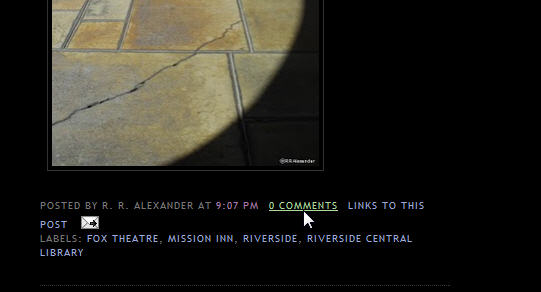
1. Click on the Comment link at the bottom of the page. The Comment link is cleverly disguised among other text, as shown below.
But maybe it is the comment process itself that is the problem. My instructions on posting a comment on this blog can be found below.
Posting A Comment
1. Click on the Comment link at the bottom of the page. The Comment link is cleverly disguised among other text, as shown below.
 |
2. The Comments text box will open. To enter your comment, remark, or rumination, click in the text box, then type. It'll help if you stay on topic, though. I know very little about many things, including aerospace engineering, French cooking, and Pre-Columbian American pottery, but topics I've written about are probably safe...
 |
3. When you're done typing, "Select a Profile" from the Comment as drop-down list, as shown below. "Anonymous" works if you don't have one of the accounts listed.
You can sign the comment in the text box, of course (or not).
 |
4. When you're ready, you can post the comment by clicking on the Post Comment button.
The comment will be routed via email through me. It may take a few hours (or a day or two, if I'm off shooting) for me to see the email, so there may be some time lag before it is public.
 |
You can also Preview your comment before posting it by clicking on the Preview button. The preview dialog box will open (below). You can post from this dialog box, in addition to the one above.
 |
So,comment away. If you like something, hate something, or both, let everyone know about it...
Sunday, April 18, 2010
A Walk Downtown
The photos in this post are from downtown Riverside, taken around midday on April 18, 2010. I woke that morning with the idea that I should take a camera on a trip to the large Central Library. It wouldn’t hurt to have some different books to read and I could shoot the Mission Inn across the street from the Library.
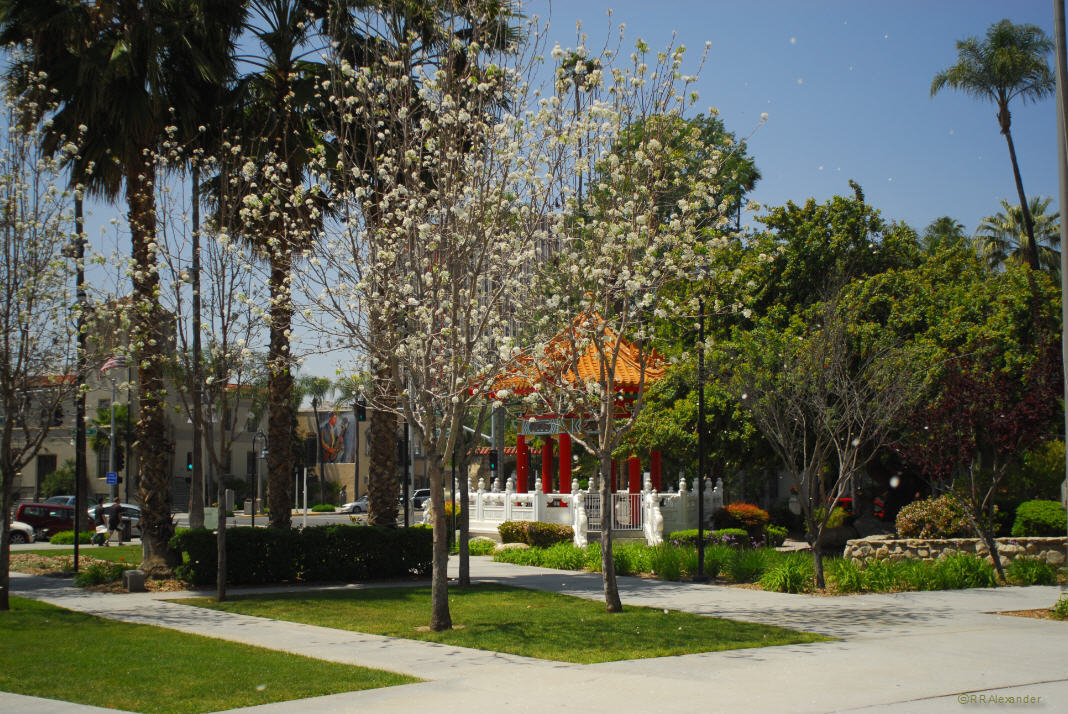
By the time I put the camera in the backpack a few hours later, the idea had evolved from a trip to the library to a photo hunt with a stop at the Library at the end. I parked beside the library and walked through its grounds. The trees in the first photo were scattering cotton-like seeds in the wind when I walked around the building’s corner toward the courtyard. That’s what the airborne “snow” in the photo is.
 |
I’ve grown to like and use the 28mm manual focus lens a great deal on the digital camera. This has had a couple of effects. I’m frequently swapping the lens between the film and digital cameras, so I’m getting more dust on the low pass filter over the sensor. I’ve grown used to cleaning the sensor using a bulb blower. I picked up some dust in the middle of the frame a week ago and used the blower. What was unexpected was that a piece of dust that had hung stubbornly on the edge of the sensor area for months was finally dislodged. I had the idea that I’d never get it off and would be editing it out of photos for the duration of the camera’s life.
 |
The pagoda on the library grounds was built to honor the contributions of Chinese immigrants who helped build Riverside. I like the way the trees behind the structure largely mask the Mission Inn and other signs of the city across the street. It creates an almost separate space in the city.
 |
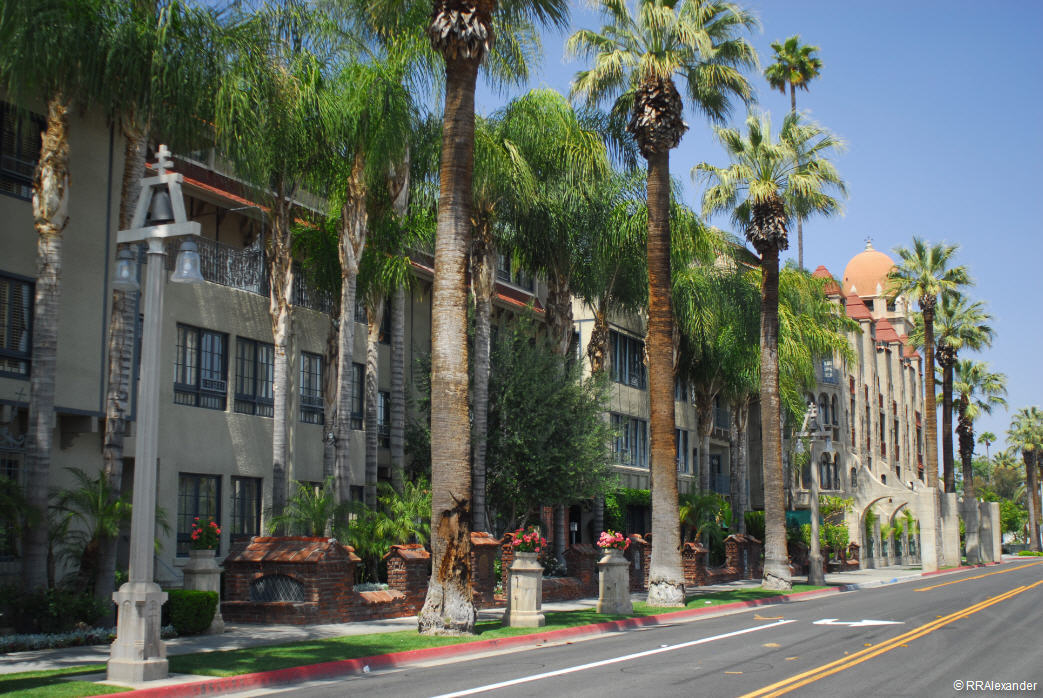
Below is the east side of the Mission Inn, which faces the Library. I lived on this side of the Inn, which takes up more than a block, in 1971-1972. It was handy at the time, having the library across the street, since I had a typewriter, and a record player, but no TV.
 |
The photos below are of the shaded walkway lining the southern flank of the inn. When I crossed the street after shooting the east face of the Mission Inn, I saw this couple walking toward me. It looked like an ad photo to me. I didn’t have time to change any settings. I looked through the viewfinder, pulled the focus back, and shot quickly.
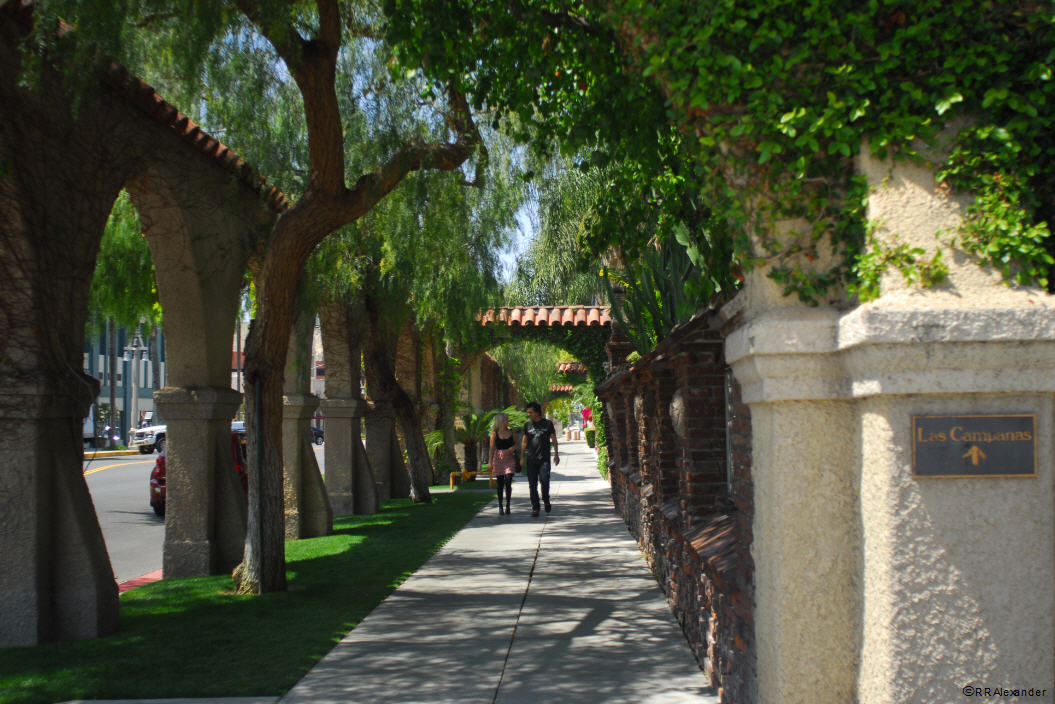 |
After shooting two more frames I noticed that the guy was quite aware that I was shooting them. I looked up from the viewfinder and said, “You two look good.” The following two frames caught their reactions to the statement.
 |
 |
The next photo is of the south side of the Mission Inn.
 The two following photos were taken at Fox Theatre on the corner of Market Street and Mission Inn Avenue. The Fox was the site of the sneak premier of Gone With The Wind eight decades ago. It was one of three operating movie theatres within walking distance of my studio apartment at the inn in 1971. Long neglected, the Fox Theatre reopened after a long restoration in January with pair of concerts by Sheryl Crow. |
 |
 |
Friday, April 16, 2010
The Obligatory Fire Hydrant Photograph
Sometimes a fire hydrant is just a fire hydrant. This is one of those times.
The fire hydrant depicted below is on my street. I watched this photo unfold itself yesterday, periodically noting how the light and tree shadows fell on the scene at different times, then walked up with the camera at 5:23pm today for the Photo.
At that time, the shadows cast on the scene were from the treetops, rather than the elongated shadows of palm and ash trunks. The long shadows nearer to sundown were likely to arrive in golden light, but I couldn't shoot because my shadow would be in the frame.
Here are the gearhead statistics: Nikon D200 body, Nikon 18-105mm VR DX 3.5-5.6 G ED lens. Aperture priority at f/9, shutter speed 1/80s, ISO 100, 58mm focal length, multi-pattern metering.
I chose f/9 to keep the twin palms behind the hydrant in focus, rather than blurring them out with the lens wide open. I rarely shoot at higher than ISO 200. If it's dark enough to think about increasing the ISO speed, 99 percent of the time I prefer the results of the longer exposure using a tripod or with the camera braced on a stable object like a boulder, etc.
A 100 percent crop of the photo is shown below. The blue tape on the top of the hydrant is what was left after a yard sale sign was posted on it a few months ago.
(There. I just achieved my lifelong goal of reasonably using the word "hydrant" five times in under 250 words. Since I began to write 54 years ago, this has been no small undertaking. Now, what's next?)
The fire hydrant depicted below is on my street. I watched this photo unfold itself yesterday, periodically noting how the light and tree shadows fell on the scene at different times, then walked up with the camera at 5:23pm today for the Photo.
At that time, the shadows cast on the scene were from the treetops, rather than the elongated shadows of palm and ash trunks. The long shadows nearer to sundown were likely to arrive in golden light, but I couldn't shoot because my shadow would be in the frame.
 |
I chose f/9 to keep the twin palms behind the hydrant in focus, rather than blurring them out with the lens wide open. I rarely shoot at higher than ISO 200. If it's dark enough to think about increasing the ISO speed, 99 percent of the time I prefer the results of the longer exposure using a tripod or with the camera braced on a stable object like a boulder, etc.
A 100 percent crop of the photo is shown below. The blue tape on the top of the hydrant is what was left after a yard sale sign was posted on it a few months ago.
 |
An Odd One

The strange flower shown here is an onion blossom. I find it rather odd looking. Last year Lisa brought home a pot with onions growing in it. I watered it along with everything else, but we never harvested the onions. It being the plants' second year, they've sent up long stalks to bud like this.
Subscribe to:
Posts (Atom)

 Posts
Posts


