
Showing posts with label Riverside. Show all posts
Showing posts with label Riverside. Show all posts
Saturday, May 7, 2011
Pastels


Friday, October 29, 2010
Golden Hour
This post appeared earlier. I updated the search terms, and the editing software stuck it here. Nothing I can do about it, though it is now out of sequence. Let's pretend this is a "feature" of the editing software, rather than a "bug".
In photography, the first and last hour of sunlight during the day is known as the Golden Hour. At those times, when the sun is near the horizon, the light appears softer and warmer, and shadows are longer. "Hour" is used quite loosely, since the length of the warm light varies with cloud cover and latitude.

The photographs in this post were made in the golden hour around sunrise.


In landscape photography, the warm glow of the low Sun is considered desirable because of the way it enhances the colors of a scene.


In photography, the first and last hour of sunlight during the day is known as the Golden Hour. At those times, when the sun is near the horizon, the light appears softer and warmer, and shadows are longer. "Hour" is used quite loosely, since the length of the warm light varies with cloud cover and latitude.

The photographs in this post were made in the golden hour around sunrise.


In landscape photography, the warm glow of the low Sun is considered desirable because of the way it enhances the colors of a scene.


Although generally warm, the color palette of the golden hour can vary widely depending on atmospheric conditions.


All of the photos in this post were made while hiking on Mt. Rubidoux. For more information about Mt. Rubidoux, see http://www.mt-rubidoux.org/.

In cinematography, this lighting is called the "magic hour". The 1978 Terrence Malick film, Days Of Heaven was photographed in golden hour light.

Friday, August 20, 2010
Camera Obscura
The photograph below is of the Wells Fargo building in downtown Riverside. I captured the photo from the third story balcony of the California Museum of Photography (CMP). The balcony provides a short walkway to the museum’s camera obscura. The lens of the camera obscura is pointed toward the Wells Fargo building. |
 |
The museum exhibits contain photographs by the likes of Ansel Adams and Edward Weston, exhibitions, and a camera collection numbering over 10,000, among other attractions. For me those things are the cake. The icing is the camera obscura. I don’t know why, but it is what prompts me to return to the museum, again and again. A camera obscura is a simple apparatus. It is basically a box with a lens mounted in one wall. Light streaming through the lens creates an image on the far wall of the box. It is a passive system. Once the device is built, it simply works. Nothing has to be done to “make” it create an image. In early versions, a pinhole was used rather than a lens. The image created by the CMP device, correctly oriented in software, is shown below. When I look at the image, I have to remind myself that this device was used to project images for many hundreds of years before the development of chemical photography, and the idea that razor-sharp focus is a desirable state developed in tandem with modern photography. |
 |
It would have been a mind-blowing experience to see a similar image during the time before modern photography, particularly depending on how the camera was oriented. The CMP camera image includes the downtown mall in front of the Wells Fargo building, so the image reflects the movement of trees and people on foot, bicycles, skateboards, etc. The CMP image can easily be considered a motion picture camera – without the ability to record the images. Though it is a relatively low-maintenance exhibition, the camera obscura does require some maintenance. What appears to be a decades-old staining is on the lens. I can see the dirt on the lens itself, and in the digital image, though it is quite minor. It makes me question a few things, though; 1. How is the lens cleaned? Is it restored with a soft rag, soap, water, and stepladder, or can the lens be removed from its mount? 2. How much difference will a lens cleaning make on the image? Will the image be noticeably brighter? 3. How often is cleaning scheduled? Is maintenance much more frequent than I assume? |
Sunday, April 18, 2010
A Walk Downtown
The photos in this post are from downtown Riverside, taken around midday on April 18, 2010. I woke that morning with the idea that I should take a camera on a trip to the large Central Library. It wouldn’t hurt to have some different books to read and I could shoot the Mission Inn across the street from the Library.
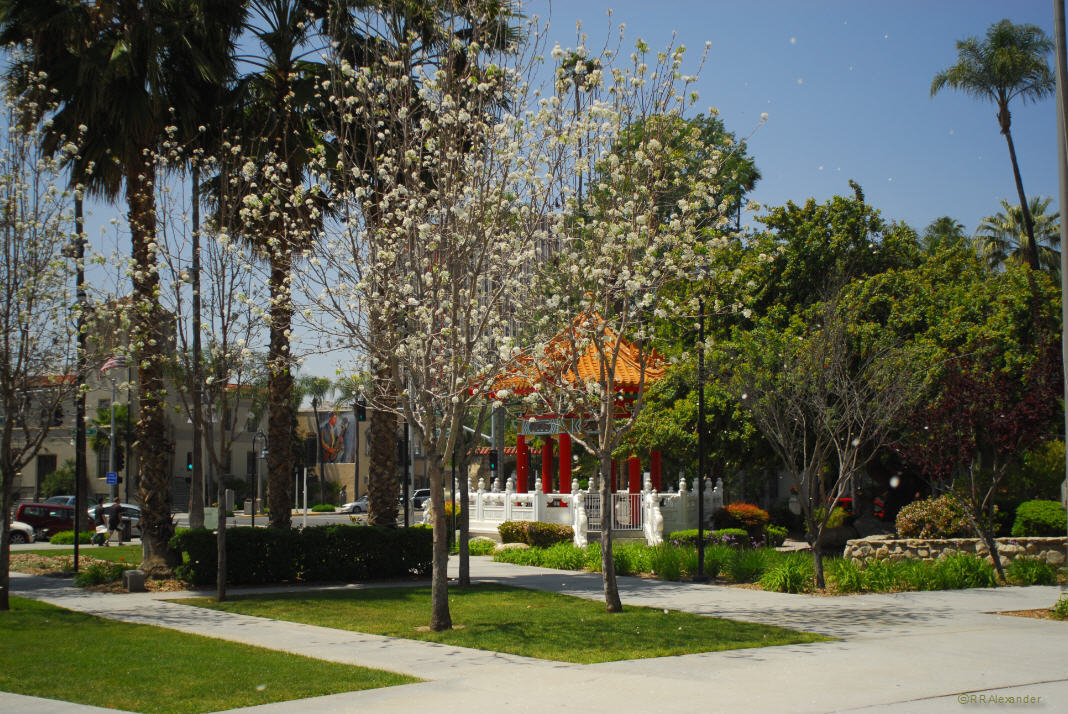
By the time I put the camera in the backpack a few hours later, the idea had evolved from a trip to the library to a photo hunt with a stop at the Library at the end. I parked beside the library and walked through its grounds. The trees in the first photo were scattering cotton-like seeds in the wind when I walked around the building’s corner toward the courtyard. That’s what the airborne “snow” in the photo is.
 |
I’ve grown to like and use the 28mm manual focus lens a great deal on the digital camera. This has had a couple of effects. I’m frequently swapping the lens between the film and digital cameras, so I’m getting more dust on the low pass filter over the sensor. I’ve grown used to cleaning the sensor using a bulb blower. I picked up some dust in the middle of the frame a week ago and used the blower. What was unexpected was that a piece of dust that had hung stubbornly on the edge of the sensor area for months was finally dislodged. I had the idea that I’d never get it off and would be editing it out of photos for the duration of the camera’s life.
 |
The pagoda on the library grounds was built to honor the contributions of Chinese immigrants who helped build Riverside. I like the way the trees behind the structure largely mask the Mission Inn and other signs of the city across the street. It creates an almost separate space in the city.
 |
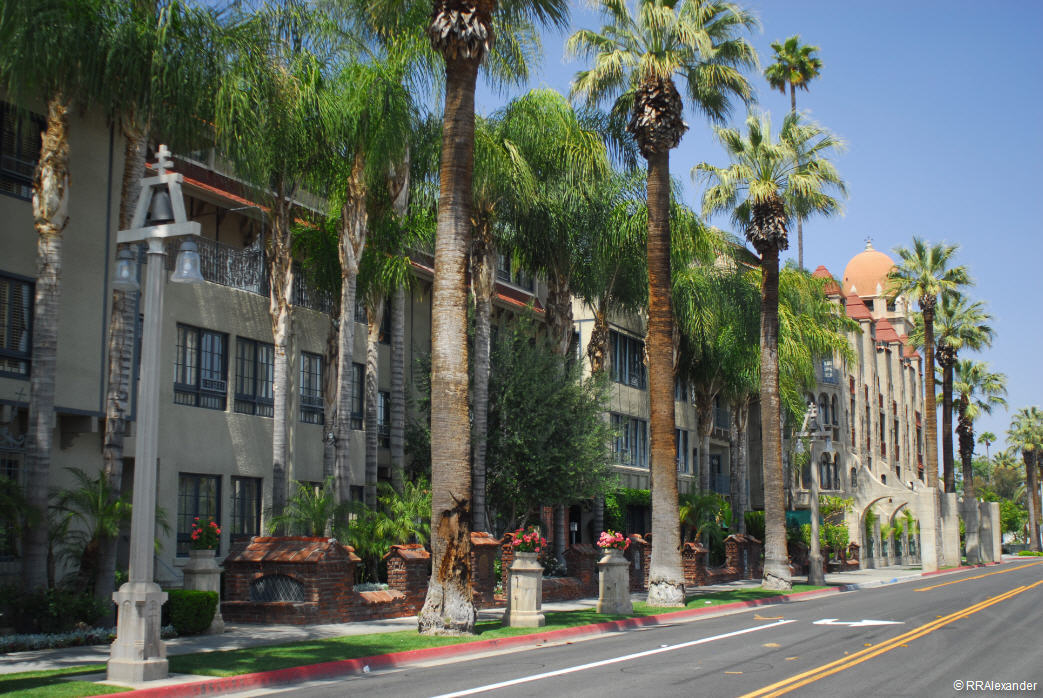
Below is the east side of the Mission Inn, which faces the Library. I lived on this side of the Inn, which takes up more than a block, in 1971-1972. It was handy at the time, having the library across the street, since I had a typewriter, and a record player, but no TV.
 |
The photos below are of the shaded walkway lining the southern flank of the inn. When I crossed the street after shooting the east face of the Mission Inn, I saw this couple walking toward me. It looked like an ad photo to me. I didn’t have time to change any settings. I looked through the viewfinder, pulled the focus back, and shot quickly.
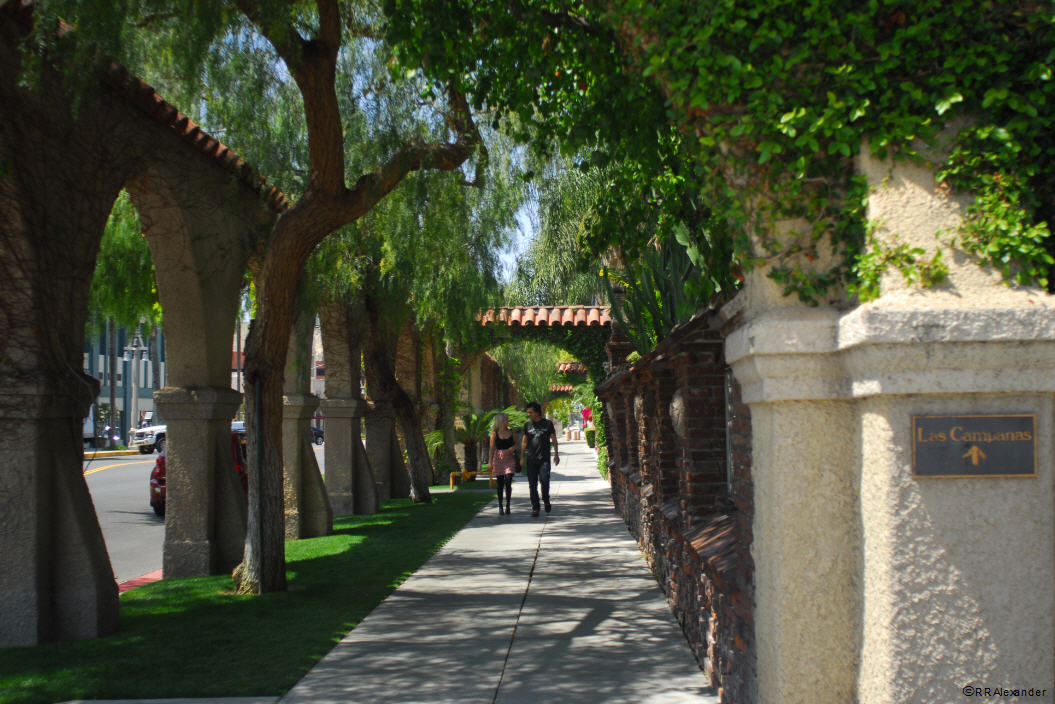 |
After shooting two more frames I noticed that the guy was quite aware that I was shooting them. I looked up from the viewfinder and said, “You two look good.” The following two frames caught their reactions to the statement.
 |
 |
The next photo is of the south side of the Mission Inn.
 The two following photos were taken at Fox Theatre on the corner of Market Street and Mission Inn Avenue. The Fox was the site of the sneak premier of Gone With The Wind eight decades ago. It was one of three operating movie theatres within walking distance of my studio apartment at the inn in 1971. Long neglected, the Fox Theatre reopened after a long restoration in January with pair of concerts by Sheryl Crow. |
 |
 |
Friday, April 9, 2010
Anza Narrows
Its nearly always a good thing to uncover a new viewpoint. I've been driving and riding by the entrance to a Riverside County Park for decades, but never stopped to see it until a couple weeks ago, though it is within a mile of my house. |
 |
It suddenly occurred to me that the Martha McLean/Anza Narrows Park might have a good view to the north, so I went to the park. The guard at the entrance let me ride in and take a look around. A short putt to the parking and picnic areas convinced me that I had to go back for the viewpoints near the first parking area. Repeatedly. Anza Narrows is an area of the Santa Ana River basin where the river meanders generally westward and flows under a multiple-arched railroad bridge. The railroad bridge is a concrete construction, but the arches look good despite the mundane building material. I walked down to the bridge once. But I only shot film, so it will be a while before those photos appear. If ever. |
 |
These digital photos were largely “test” shots for the 35mm SLR. Though engineered more than a decade apart, the N90s’ area metering and the D200’s matrix metering kept matching each other spot-on. The view above is of Mt. Rubidoux and the buildings of downtown Riverside in the far distance. The bike trail in the foreground runs from the Inland Empire along the river through a long canyon bordering the mountains of the Cleveland National Forest to Orange County on the coastal plain. |
 |
Is that Hawaii? No, but it does look quite tropical. Its another view of the Santa Ana River bottom. |
 |
The photo above is another long view of Mt. Rubidoux and downtown Riverside. Note that you can’t see the concrete trails, because I walked back to the crest of the slope, which blocked them from my line-of-sight. |
 |
The above photo is yet another reason to visit Anza Narrows frequently. The park, like all Riverside County Parks has a per-vehicle entrance fee. $5 for an automobile. $2 for a bicycle or motorcycle. I paid the $2.00 entrance fee a couple times then bought a one year pass to all County parks for $25. I’ll be going to the narrows frequently, since it is so close by, but the pass also covers an additional thirteen regional parks and a number of recreation centers. |
Friday, November 20, 2009
Riverside Views
The photographs in this post are various views of Riverside, California. Many were taken during or before sunrise or sunset.
 The photo above is a view to the west from Sycamore Canyon.
 This one was captured minutes after sunrise, and minutes before the
moon would set. View to the west from Mount Rubidoux.
 Lake Edwards, Riverside. This water reservoir's placid surface
 The photo above was captured from the lower (east side) trail on Mt. Rubidoux.
 View northeast from Tower Road, Riverside.
 Double rainbows over Mt. Rubidoux
 Predawn view east over Riverside's downtown area.
 March Air Museum at March AFB, known as March Air Field in WWII.
 Sunset from Sycamore Canyon.
 From Tower Road, Riverside.
 It's somewhat perverse, but I liked the
 The photo above is a view to the west from Sycamore Canyon.
 This one was captured minutes after sunrise, and minutes before the
moon would set. View to the west from Mount Rubidoux.
 Lake Edwards, Riverside. This water reservoir's placid surface
 mirrors the sky. Though the lake is man-made, it seems primeval,
the setting for the beginning of some new life form.
 The photo above was captured from the lower (east side) trail on Mt. Rubidoux.
 View northeast from Tower Road, Riverside.
 Double rainbows over Mt. Rubidoux
 Predawn view east over Riverside's downtown area.
 March Air Museum at March AFB, known as March Air Field in WWII.
 Sunset from Sycamore Canyon.
 From Tower Road, Riverside.
 It's somewhat perverse, but I liked the
 streetlamp looming over the freeway and the mountains.
View from Sycamore Canyon Boulevard, Riverside.
 From Tower Road, Riverside.
 This is one of my favorite views. A different photo of the same view
View from Sycamore Canyon Boulevard, Riverside.
 From Tower Road, Riverside.
 This is one of my favorite views. A different photo of the same view
 appears in another Crossings post. View from the lower trail, Mt. Rubidoux.
 View northwest from Sycamore Canyon.
 View northwest from Sycamore Canyon.
 Tuesday, June 30, 2009
Palm Trees
When I moved to Southern California I had never seen palm trees, which were not native to the cold northeastern U.S. where I spent the first twenty years of my life. I arrived in the darkness around 4:00am, and was initially fascinated by the abundance of palms, which I began seeing a couple hours after that first sunrise. Now nearly four decades later, I'm no longer fascinated by them, but I still pay them a certain amount of attention.
The photographs in this post were made on the first day of summer in 2009, at Fairmount Park in Riverside, California.


Subscribe to:
Posts (Atom)

 Posts
Posts


